
What if your biggest challenge as a team leader isn’t planning or managing a project, but knowing how to read the room as a leader? When you’re leading a team or a project, it’s easy to focus only onmoving things forward, making decisions, meeting deadlines, and driving results. And that makes sense: progress matters.
But here’s the paradox: getting things going can be faster and far less complicated when you do read the room. And here’s why: outcomes don’t happen because of plans alone. They happen because people execute them.
When you read the room, you are observing with the people who will execute your plan to ensure everyone is on the same page. You’re looking for cues to understand where people stand and whether anything still needs to be clarified, included, or addressed to reach your goal efficiently.
You’re watching for:
- Where buy-in already exists
- Where objections might slow the process later
- What questions or ideas could strengthen the outcome?
- Who needs clarity, and who can help move things forward?
Ignoring those signals doesn’t necessarily speed things up. It can lead to delays, unplanned additions, or quiet resistance.
Learning how to read the room as a leader helps you surface obstacles early, sharpen your message, and focus your energy where it will actually move the work forward. Most importantly, it signals that you value and respect the people in the room. People are more likely to engage, contribute, and follow through when they feel seen and respected, not managed or pushed.
Signals Leaders Often Underuse
Body language, micro-expressions, and behavioral cues rarely tell the whole story, but they can signal underlying dynamics you need to understand. These are clues, not conclusions. Observing them helps you decide when to clarify, probe deeper, or engage more directly so you can determine what’s actually happening.
Engagement Cues
Behaviors that may signal interest and are worth leaning into:
- Leaning forward or facing the conversation may indicate someone is tracking or focused.
- Eye contact during key points can signal attention, though lack of eye contact doesn’t always mean disengagement.
- Taking notes may suggest they’re capturing action items or processing information.
- Asking questions can signal curiosity or a need for clarity.
Key approach: Treat these cues as prompts to explore, not proof of agreement or buy-in. Use them as openings to ask clarifying questions, confirm understanding, and invite input so you can verify alignment.
Resistance Cues
Certain behaviors might indicate hesitation, skepticism, or distraction, but context matters:
- Crossed arms or a closed posture may suggest disagreement or concern, or it could simply be a posture.
- Glancing at the clock or door could signal impatience or awareness of another commitment.
- Early agreement without discussion may reflect genuine support or an avoidance of conflict,
- Checking phones or looking away could signal distraction, multitasking, or fatigue.
Key approach: Use these cues as signals to slow down and verify. Ask open questions or check in directly to surface concerns before they become obstacles.
Power and Influence Cues
Understanding informal dynamics helps you prioritize where to focus your energy and who to engage sooner rather than later:
- Who speaks immediately after the leader? They often influence the tone of the discussion.
- Who do others glance at before responding? That person’s perspective may carry weight.
- Who stays quiet but takes detailed notes? They may influence decisions later or shape implementation.
Key approach: Notice these patterns without jumping to conclusions. Confirm who holds influence, build the right relationships, and follow up strategically to move the work forward.
how to read the room as a leader
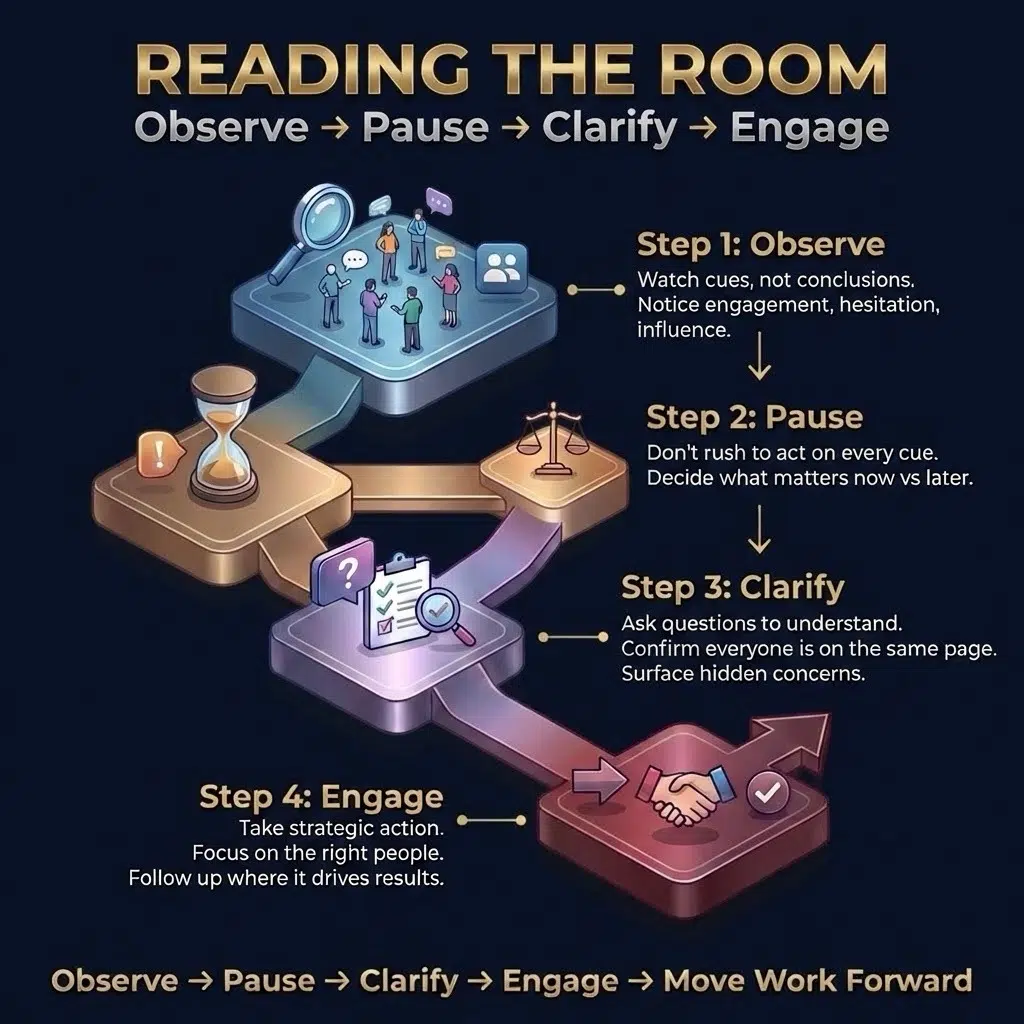
Noticing signals is only useful if you turn what you see into practical steps that move work forward. Learning how to read the room as a leader begins by preparing before you even step into the room and continues afterward.
Before a meeting: know who will be present, what perspectives they bring, and what concerns or questions they might raise. Strategize how you will engage the right people, address potential obstacles, and set the conversation up to achieve results.
During a meeting: notice engagement, hesitation, and influence patterns. Ask targeted questions to clarify understanding, uncover hidden concerns, or draw in perspectives that will strengthen the outcome.
After a meeting: follow up selectively, focusing on the people or issues that matter most. Reflect on what went well, what signals you observed, and where you may need to adjust your approach next time.
Final Thought
While these cues were grouped into categories, engagement, resistance, and influence, the goal isn’t to memorize which behavior fits where. The real skill is developing the awareness to notice any shift in body language, micro-expressions, or behavior, and using it as a signal to pause and think.
When you observe something, don’t rush past it. Consider what might be behind it. Ask a question. Acknowledge what you’re sensing. Clarify if needed.
And if the moment doesn’t allow you to address it right away, make a note and follow up later. Not every signal needs to be handled publicly or immediately, but it shouldn’t be ignored.
When you know how to read the room as a leader, you become more attuned to your team and can respond in ways that build trust, clarity, and momentum.